Therapy in Florida for Anxiety & Perfectionism
Therapy in Florida for anxiety and perfectionism can help when your mind rarely seems to shut off. You may appear capable and successful while privately dealing with overthinking, self-criticism, constant pressure, burnout or the feeling that you should always be doing more.
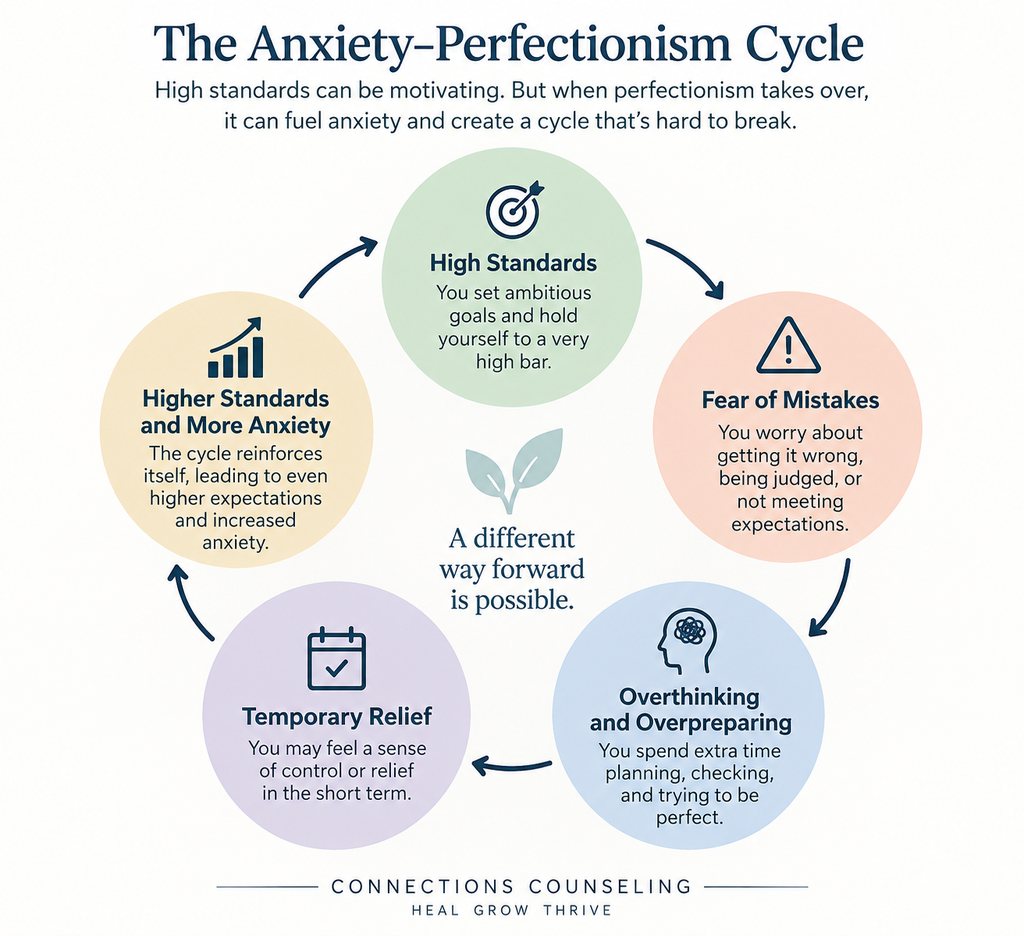
When Anxiety and Perfectionism Feed Each Other
Anxiety can make you question whether you have prepared enough, made the right decision, or overlooked something important. Perfectionism can respond by pushing you to check again, work harder, overprepare, or avoid making a mistake.
Even when you know your expectations are unrealistic, lowering them can feel uncomfortable. You may worry that if you stop pushing yourself, something will go wrong—or that you will disappoint yourself or someone else.
Anxiety and Perfectionism Can Look Like
- Overthinking conversations or decisions
- Fear of making mistakes
- Difficulty making decisions without second-guessing yourself
- Setting extremely high standards for yourself
- Procrastinating when you are unsure you can do something well
- Repeatedly revising or checking your work
- Difficulty accepting “good enough”
- Harsh self-criticism
- Worry about disappointing others
- Comparing yourself to other people
- Difficulty relaxing when something remains unfinished
- Feeling responsible for preventing problems before they happen
Why Perfectionism Can Make Anxiety Worse
Perfectionism often creates rules about what you must do to feel safe, successful, or good enough. A mistake may feel more significant than it actually is, while uncertainty can create an urge to prepare more, check again, or keep thinking until you find the “right” answer.
The problem is that perfection is an impossible standard. The more you rely on certainty or flawless performance to reduce anxiety, the harder it can become to tolerate normal mistakes, ambiguity, and situations you cannot completely control.
How Therapy Can Help
Therapy can help you recognize the thoughts, beliefs, and behaviors that keep anxiety and perfectionism going. Instead of simply telling yourself to “stop worrying” or lower your standards, we look at what drives the pattern and practice responding differently.
Treatment may incorporate CBT, ACT, IFS-informed parts work, and other evidence-based approaches based on your needs. The goal is not to stop caring about your work or lower the standards that matter to you. It is to develop more flexibility so anxiety and perfectionism are not making your decisions for you.
Learning to Tolerate “Good Enough”
For someone with perfectionistic tendencies, “good enough” can feel surprisingly uncomfortable. You may understand intellectually that something does not need to be perfect while still feeling compelled to revise it, rethink it, or make absolutely sure you got it right.
Therapy can help you practice tolerating that discomfort without automatically responding to it. Over time, you can learn to recognize when excellence reflects your values and when perfectionism is asking you to chase certainty that does not actually exist.
When Anxiety and Perfectionism Affect Your Relationships
These patterns do not always stay at work or inside your own head. You may have difficulty asking for help, feel responsible for keeping everyone happy, overthink how others perceive you, or become frustrated when things are not handled the way you expected.
Therapy can help you notice these patterns without giving up the qualities you value. You can learn to communicate more directly, set healthier expectations, and allow yourself and the people around you to be imperfect.
Online Therapy in Florida for Anxiety & Perfectionism
We provide online therapy to adults 18+ throughout Florida who struggle with anxiety, perfectionism, overthinking, and self-criticism. Telehealth allows you to work on these patterns from a private, familiar space without adding travel time to an already busy schedule.
Sessions are individualized around the patterns affecting your life, relationships, and decisions. Together, we focus on practical changes you can use outside of therapy—not just understanding why the pattern exists.
Frequently Asked Questions About Anxiety & Perfectionism
Is Perfectionism a Mental Health Diagnosis?
Perfectionism itself is not a mental health diagnosis. However, perfectionistic patterns can contribute to anxiety, chronic self-criticism, avoidance, procrastination, and difficulty tolerating mistakes or uncertainty. Therapy focuses on how these patterns affect your life rather than simply labeling you as a perfectionist.
What Is the Difference Between Perfectionism and OCD?
Perfectionism and OCD can overlap, but they are not the same thing. Perfectionism often involves high standards, fear of mistakes, and self-criticism. OCD involves obsessions and compulsions that create a cycle of distress and temporary relief. If your symptoms appear more consistent with OCD, treatment may include Exposure and Response Prevention (ERP).
Can Therapy Help Me Stop Overthinking Everything?
Therapy can help you recognize when productive problem-solving has turned into repetitive overthinking. You can learn to respond differently to uncertainty, make decisions without endlessly reviewing every possibility, and become more comfortable moving forward without absolute certainty.
Will Therapy Make Me Less Driven or Successful?
No. The goal is not to take away your ambition, work ethic, or high standards. Therapy can help you separate healthy achievement from anxiety-driven pressure so you can pursue what matters to you without feeling that every decision, mistake, or outcome determines your worth.
Therapy in Florida for Anxiety and Perfectionism
Yes. We provide online therapy for adults 18+ throughout Florida. Telehealth allows us to work on anxiety and perfectionism as they show up in your everyday life while giving you the convenience of attending sessions from a private location that works for you.
Ready to Quiet the Pressure
You do not have to give up your ambition or lower the standards that matter to you. If anxiety, overthinking, or perfectionism are taking up too much mental space, therapy can help you develop a more flexible way to move forward.